> ## Documentation Index
> Fetch the complete documentation index at: https://docs.laces.run/llms.txt
> Use this file to discover all available pages before exploring further.
# Hosted checkout
> Send the buyer to a Laces checkout page and back to your site. No payment UI to build; works on a static site.
Hosted checkout is the quickest integration. Your page creates a **checkout
session** for an event, sends the buyer to the Laces page it returns, and gets
the buyer back when they finish. Laces handles the form, the waiver and the
payment: mobile money (MTN and Airtel) today, card coming soon.
**You need:** an API key with **Start hosted checkout**
(`checkout_sessions:write`), your site's origin in **Allowed domains** and in
**Return URL domains**. See [Getting your API keys](/api-keys).
Every key, token and id on this site is a made-up example value. Your real
keys are issued to you in the Laces app, under **Settings → Developers**.
## The flow
```mermaid theme={null}
sequenceDiagram
autonumber
participant B as Buyer's browser
participant S as Your server
participant L as Laces API (connect.laces.run)
participant C as laces.run checkout
B->>L: POST /checkout-sessions (publishable key)
L-->>B: 201 { id, url, expires_at }
B->>C: Redirect to url
C-->>C: Buyer fills the form and pays (mobile money)
alt Paid
C-->>B: "Return to {organization}", auto-redirect after ~5 s
B->>S: GET on_success_url?session_id=LCSCS-…
S->>L: GET /checkout-sessions/{id} (bearer)
L-->>S: status: complete, order.status: paid
S-->>B: "You're registered"
else Cancelled
C-->>B: Redirect to on_cancel_url
end
L-)S: Webhook order.paid
```
1. **Your page** creates a session: `POST /checkout-sessions` with the
event and your two return URLs. From the browser, use the publishable key.
From your server, use a bearer token.
2. Laces returns `{ id, url, expires_at }`, where `url` is
`https://laces.run/checkout/{id}`.
3. **Redirect** the buyer to `url`.
4. On laces.run the buyer sees a registration form for exactly that event,
with your `prefill` filled in and a "Cancel and return to
*your organization*" link. They fill it in and pay.
5. **Cancel** sends them to `on_cancel_url`.
6. **Success** shows a confirmation with a "Return to *your organization*" button
and redirects automatically after about 5 seconds to `on_success_url`,
carrying the session id.
7. **Your server verifies** the session before fulfilling anything.
### What the buyer sees
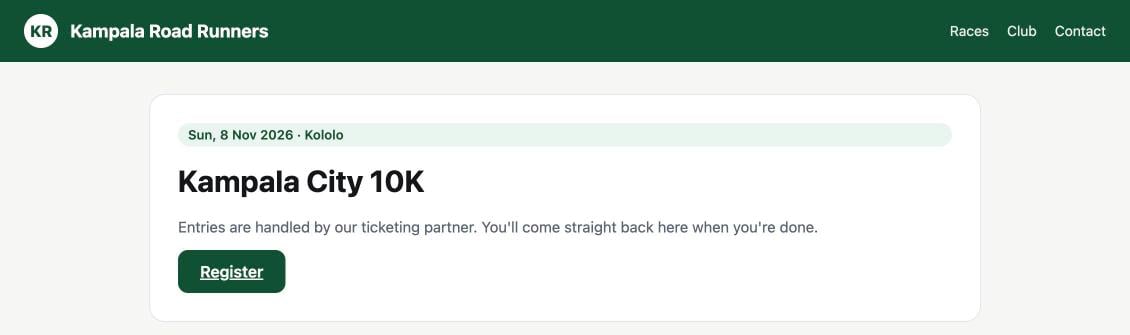
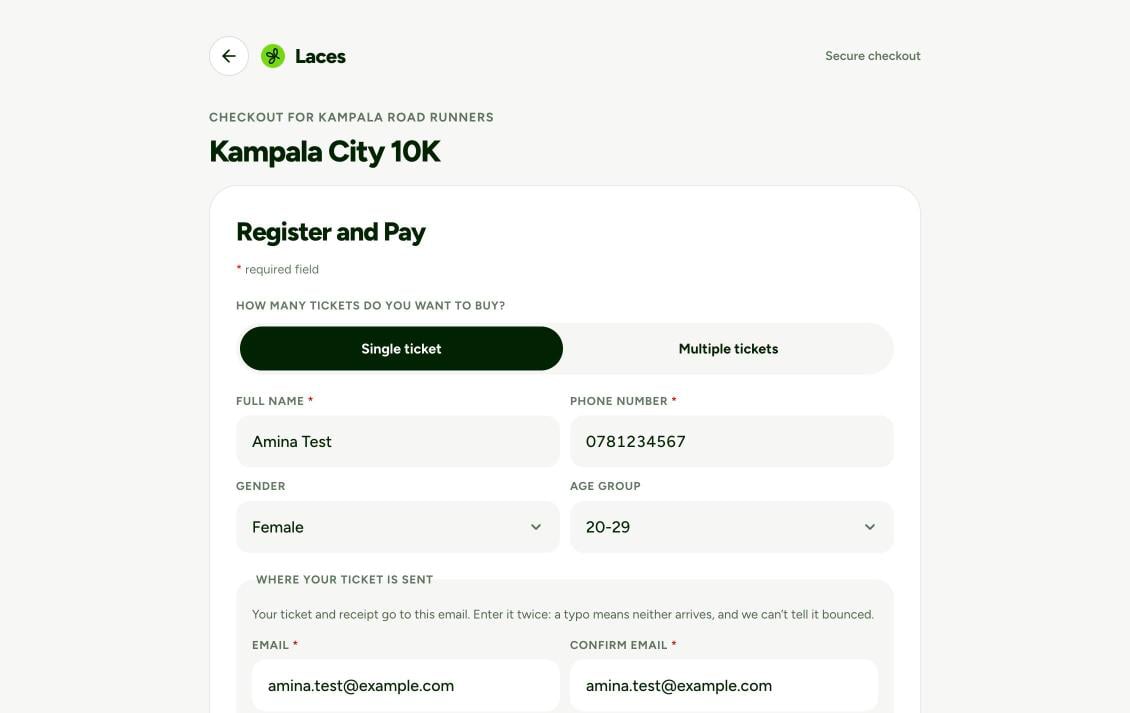
The buyer clicks **Register** on your event page.
Laces opens the form for exactly that event, labelled with your
organization's name. Anything you sent in `prefill` is already filled in.
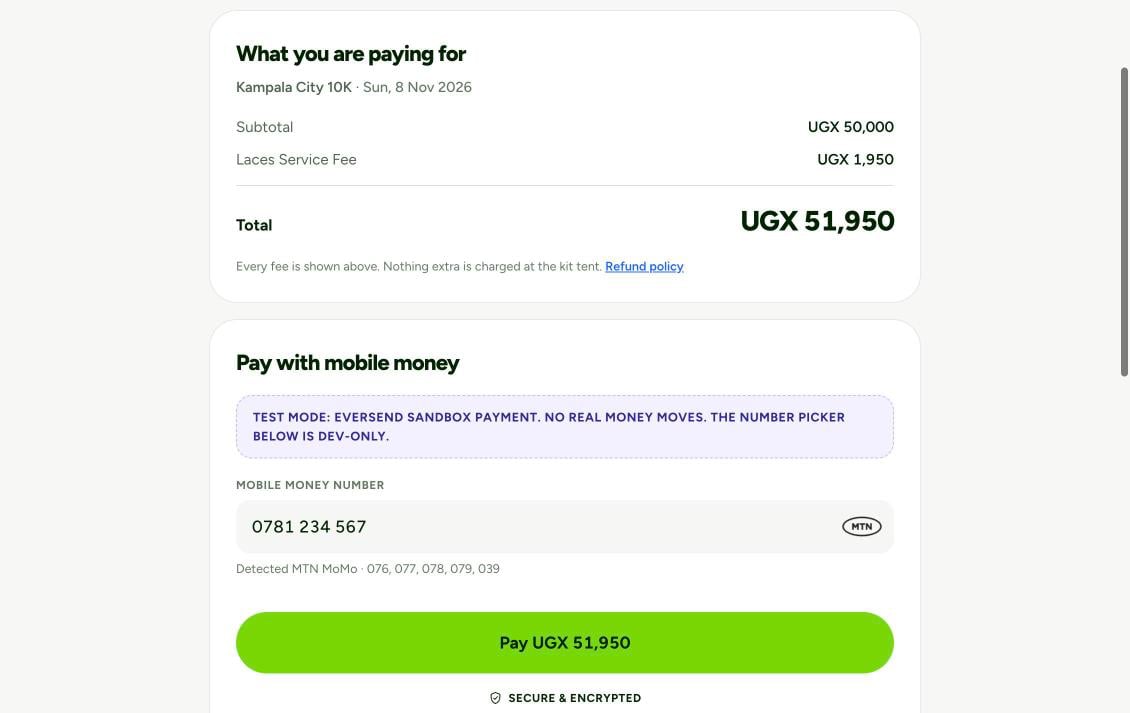
The buyer sees every fee before paying, enters their MTN or Airtel number
and taps **Pay**.
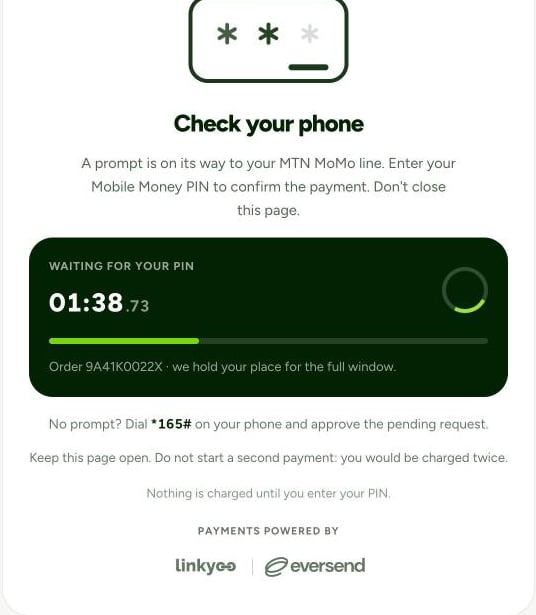
A prompt then arrives on the buyer's phone, and the page waits while they
enter their PIN.
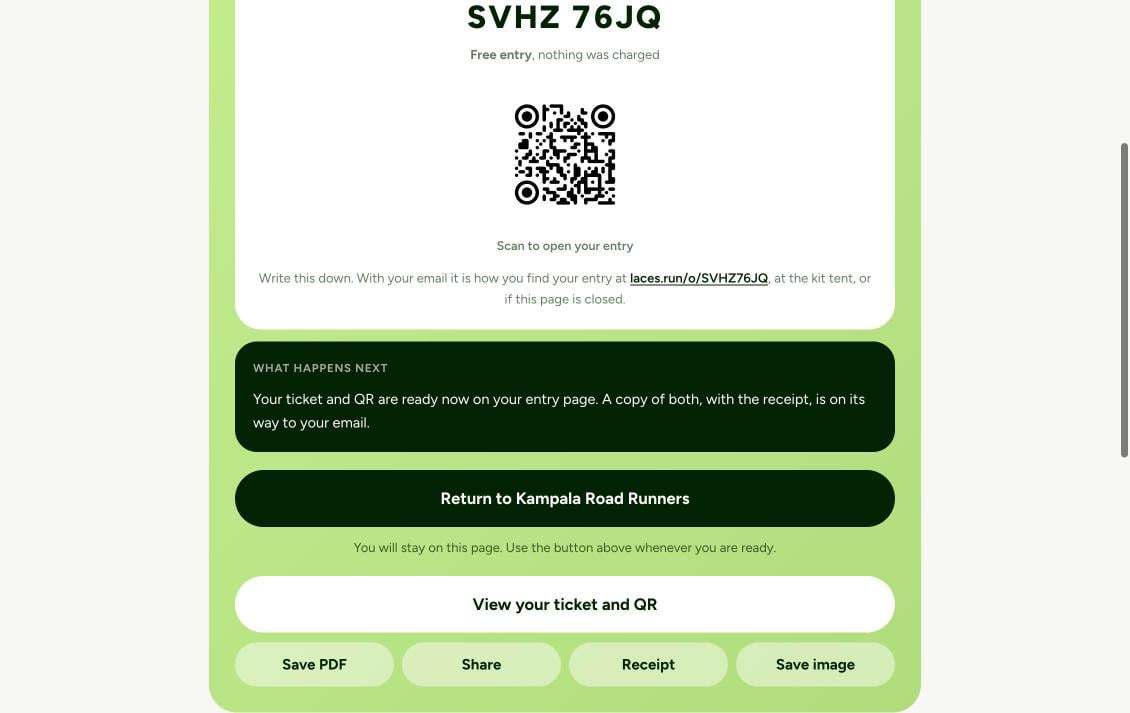
The buyer gets their order code and ticket, and a **Return to** button labelled with your organization's name. Laces sends them back to your `on_success_url`
automatically after about 5 seconds.
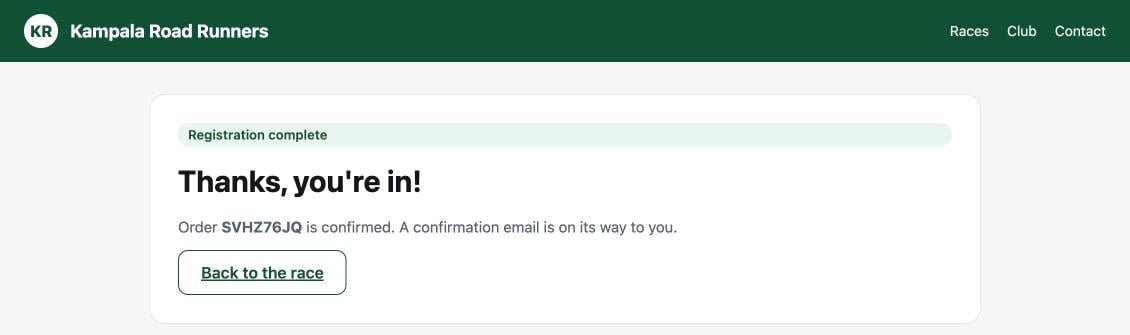
Your server verifies the session (step 2 below) and shows its own
confirmation.
## 1. Create the session
```html Browser (publishable key) theme={null}
```
```bash Server (bearer token) theme={null}
curl -s -X POST "$BASE/checkout-sessions" \
-H "Authorization: Bearer $TOKEN" \
-H "Content-Type: application/json" \
-d '{
"event_id": "q3Zk9mVx",
"on_success_url": "https://shop.example.com/thanks?session={CHECKOUT_SESSION_ID}",
"on_cancel_url": "https://shop.example.com/events/kampala-city-10k",
"client_reference_id": "cart-8841",
"prefill": { "buyer_name": "Amina Nakato", "buyer_email": "amina@example.com" }
}'
```
Response `201`:
```json theme={null}
{
"code": 201,
"message": "Checkout session created successfully",
"data": {
"id": "LCSCS-EXAMPLESESSN234EXAMPL",
"url": "https://laces.run/checkout/LCSCS-EXAMPLESESSN234EXAMPL",
"expires_at": "2026-10-10T08:14:03.000Z",
"ui_mode": "redirect"
}
}
```
| Field | Required | Notes |
| - | - | - |
| `event_id` | Yes | Your organization's event |
| `on_success_url` | Yes | Where the buyer goes after paying |
| `on_cancel_url` | Yes | Where the buyer goes if they cancel |
| `client_reference_id` | No | Your reference, up to 256 characters. Returned when you read the session. |
| `prefill` | No | `{ "buyer_name", "buyer_email", "buyer_phone" }`, all optional (up to 120, 254 and 32 characters) |
| `ui_mode` | No | `redirect` (the default). `embedded` is for [embedded checkout](/guides/embedded-checkout). |
Sessions **expire after 24 hours**, and each session is for one event. Create
one when the buyer clicks, not when the page loads.
### Return URL rules
Both URLs must be absolute `https` URLs, at most 2048 characters, with no
username or password, whitespace or backslashes, and their **origin must
exactly match** one of your return URL domains. This is what stops Laces
checkout being used as an open redirect.
The one exception is local development: `http://localhost:` and
`http://127.0.0.1:` return URLs work, end to end, when you have
registered that exact origin in **Return URL domains**. See
[Local development domains](/api-keys#local-development-domains).
### Getting the session id back
* Put the literal placeholder `{CHECKOUT_SESSION_ID}` anywhere in
`on_success_url`, and Laces substitutes the real id:
`https://shop.example.com/thanks/{CHECKOUT_SESSION_ID}`. The URL-encoded
form `%7BCHECKOUT_SESSION_ID%7D` works too, so a URL built with
`new URL()` or `encodeURIComponent` is fine.
* With **no placeholder**, Laces adds `session_id=LCSCS-…` as a query
parameter (replacing any `session_id` you already had there).
* `on_cancel_url` is used as given, with no id added.
## 2. Verify on your server
**Never fulfil an order on the browser's word alone.** A redirect to your
success page, or an `onSuccess` callback in the page, is user experience,
not proof of payment. Anyone can type your success URL. Before you mark
anything paid, confirm it on your **server**: read the session with
[`GET /checkout-sessions/{id}`](/api-reference/v1/checkout-sessions/get)
and require `status: "complete"`, or act on a signed
[`order.paid` webhook](/guides/webhooks).
On your success page's route, read the session with a bearer token:
```js Node (Express) theme={null}
// GET /thanks?session=LCSCS-...
app.get("/thanks", async (req, res) => {
const sessionId = String(req.query.session || "");
const token = await getLacesToken(); // cached; see Authentication
const r = await fetch(
`${BASE}/checkout-sessions/${encodeURIComponent(sessionId)}`,
{ headers: { Authorization: `Bearer ${token}` } },
);
if (!r.ok) return res.status(400).send("We couldn't verify your payment.");
const { data } = await r.json();
const cart = await currentCart(req); // the buyer's cart, from your own session cookie
if (!cart || data.client_reference_id !== cart.id) {
return res.status(400).send("This payment doesn't belong to your cart.");
}
if (data.status !== "complete" || data.order?.status !== "paid") {
return res.send("Your payment isn't complete yet. We'll email you when it is.");
}
await fulfil(cart, data.order); // idempotent: the webhook may get here first
res.send(`You're registered. Order ${data.order.code}.`);
});
```
```python Python (Flask) theme={null}
@app.get("/thanks")
def thanks():
session_id = request.args.get("session", "")
r = requests.get(
f"{BASE}/checkout-sessions/{quote(session_id, safe='')}",
headers={"Authorization": f"Bearer {get_laces_token()}"},
timeout=30,
)
if not r.ok:
return "We couldn't verify your payment.", 400
data = r.json()["data"]
cart = current_cart() # the buyer's cart, from your own session cookie
if not cart or data["client_reference_id"] != cart.id:
return "This payment doesn't belong to your cart.", 400
if data["status"] != "complete" or (data["order"] or {}).get("status") != "paid":
return "Your payment isn't complete yet. We'll email you when it is."
fulfil(cart, data["order"]) # idempotent
return f"You're registered. Order {data['order']['code']}."
```
Response `200`:
```json theme={null}
{
"code": 200,
"message": "Checkout session retrieved successfully",
"data": {
"id": "LCSCS-EXAMPLESESSN234EXAMPL",
"status": "complete",
"ui_mode": "redirect",
"event_id": "q3Zk9mVx",
"client_reference_id": "cart-8841",
"order": {
"id": "Hk2mQ8vR",
"code": "LC-7K2M9X",
"status": "paid",
"total": 52400,
"currency": "UGX"
}
}
}
```
| `status` | Meaning |
| - | - |
| `open` | Not paid yet and not expired. `order` is `null` until the buyer starts a cart. |
| `complete` | The linked order is paid. It stays `complete` if the order is later refunded, and after the 24 hours. |
| `expired` | 24 hours passed without a paid order |
`order` is the **most recent** order made through the session, so a buyer who
retries after a failed payment shows their latest attempt. Expired sessions
are deleted automatically some time after they expire, after which a read
returns `404 not_found`, so verify promptly and keep your own record.
Always send `client_reference_id` (your cart id) when you create the session,
and check it on return. That stops a session id from someone else's purchase
being replayed against your buyer's cart. If you create sessions from your
server, also store the returned session id with the cart.
The redirect can be lost: the buyer closes the tab, or their connection
drops. Subscribe to the [`order.paid` webhook](/guides/webhooks) as well, and
match it to your cart with `attribution.checkout_session_id`. Fulfil on
whichever arrives first, idempotently.
## Errors
| HTTP | `error_code` | What to do |
| - | - | - |
| 400 | `invalid_request` | `event_id` missing, or `prefill` / `client_reference_id` invalid |
| 400 | `invalid_return_url` | Fix the URL, or add its origin to **Return URL domains** |
| 401 | `invalid_key` | The publishable key is wrong, replaced by **Regenerate keys**, or revoked |
| 403 | `origin_not_allowed` | Add this page's exact origin to **Allowed domains** |
| 403 | `payments_disabled` | Your organization isn't cleared to take payments yet. Hide the button (check `payments_enabled` on the event first). |
| 404 | `not_found` | The event isn't yours, or is a demo or code-locked event |
| 409 | `sale_closed` | Registration isn't open. Show "Registration closed". |
| 429 | `rate_limited` | Wait the seconds in `Retry-After`, then let the buyer try again |
A session is never created for an organization that can't sell, so a buyer is
never sent to a checkout page that can't take their money. Read
`payments_enabled` from [`GET /events/{eventId}`](/api-reference/v1/events/get)
to decide whether to show the button at all.
## Test it
There is one environment, so you test with your live key and a real checkout.
See [Testing your integration](/concepts/testing) for the full approach.
1. Create an **unlisted** test event in the Laces app with a free or
low-price ticket.
2. Add your site's origin to **Allowed domains** and **Return URL domains**:
your staging site, or `http://localhost:` while you develop.
3. Click Register, complete the checkout, and land on your success URL.
4. Confirm your server's session read says `complete`, and that the
`order.paid` webhook arrived.
5. Refund the order from the Laces app if you paid for it.
This documentation is built and hosted on [Mintlify](https://mintlify.com), a developer documentation platform.
 A prompt then arrives on the buyer's phone, and the page waits while they
enter their PIN.
A prompt then arrives on the buyer's phone, and the page waits while they
enter their PIN.